
The Hydred Goldberg story
How trauma, rehabilitation, and stubborn hope converged into athletic
excellence and a life beyond prognosis.
By Rodney Folmar, Sr.
I was seventeen, a social butterfly skating through the last days of high school, flitting from crowd to crowd, chasing the next laugh, the next conversation, the next joke that would land just right. I mingled with all the crowds; I like rubbing elbows with everyone.
School for me, was a place to meet people, to feel the pulse of belonging. Grades? They came and went like summer rain. What stuck was the rhythm of being seen, of moving through rooms where every table was a conversation, every hallway a chance to connect.

Then the world tilted
We were in Northern California, heading back from the outlet mall five days after my eighteenth birthday. My youngest sister Hildebrand in the back seat, me in the front seat, my boyfriend Stephen at the wheel. A car that had always seemed a little quirky, a little unreliable, but always something we could count on—until it wasn’t.
He fixed it up, gave it a beautiful paint job, eggshell and hunters green as I recall, with white wall tires. The old VW Bug would shudder when it hit a certain speed, the wheel a loose cannon, the ride a roll of the dice. That day, the wheel cried out one more time, and the car was jolted into the center divider, ping-ponging us into the slow lane, a ditch, then a telephone pole, a moment that felt as if the world slowed just enough to watch me fall apart. The moment halted every breath in my lungs.
The car stopped rolling, but the noise didn’t—the crash, the metal screaming, the glass, the scream in the air that wasn’t mine but felt like it was. I reached for something I could not name, a tether to the life I knew, and then everything went quiet with brutal clarity.

The Sound that Marked a Turning Point
Ambulance sirens loud in the background of a memory you want to mute. People appeared the way a crowd does in a bad dream—faces hovering, don’t move, asking questions you can’t answer, in a fog of pain and disbelief. First Stephen, then Hilderbrand, then me. We were all airlifted to different hospitals to begin a journey that would mark a turning point. I learned quickly who mattered in life: the people you can’t imagine living without—the people who would become my anchor, my argument against the dark.
The chaos of the hospital is a place where time refuses to be friendly. They say the surgery lasted 8 hours. I remember the ICU, the long hours that stretched into an almost mythic duration, and the moment when the doctors sat down with me and spoke words that felt like a betrayal and mercy all at once.
“You will not walk again”. “You are paralyzed from the waist down”; the words said in careful, practiced tones. It’s a sentence you don’t know how to hear, not when your body has suddenly become a map you don’t recognize.
I did not want to hear it. Not then. Not so bluntly. In my head, I clung to the other version of myself—the one who could still dream in color, who would rise from the hospital bed with a plan, a new normal that still looked like me, just more formidable.
In the Weight of Waited Truth: From Belief to Reality
It would be months before I understood what my body was telling me, months before I could admit to the possibility that my life was changing in a way I hadn’t asked for or anticipated. The days blurred into routines of therapy—learning to roll over, to lift my head, to push myself up with my arms, to transfer from bed to chair, from chair to toilet. Small, exhausting victories that felt both futile and monumental, like steppingstones across a river I hadn’t chosen to cross.

I had been bedridden for some time, but thought if I fought hard enough, if I did everything, they told me, I could walk out of here. I could still feel the old me—the social butterfly who could charm a room with a smile, who loved the energy of friends, who believed life would return to normal, because graduation was still the lighthouse I aimed to reach.
Each day carried a measured, almost patient sense of progress, not mapped in bold strides but in careful, incremental steps that felt earned rather than given. The idea of going home hovered like a quiet beacon, inviting a future where courage would show up in the steady choice to keep moving, even when the path was uncertain.
Going Home
Going home wasn’t a single moment; it was a slow, uncertain slide from the sterile rhythm of hospital walls to the rough, ordinary life beyond them. Five or six months of rehab—through ICU to the long corridor of rehab, where bells and alarms finally yielded to the hush of a life that had to relearn itself. And when the hospital bells finally stopped their relentless chime of oversight, I was allowed to go home.
My three sisters (Cherwynne, Clythess, and Hildebrand) stepped into roles that weren’t designed for their ages and certainly not designed for a teenager who suddenly depended on others for the simplest things—getting out of bed, reaching for a glass, maneuvering a chair through a doorway. They swapped their ordinary schooling for something more flexible, hours that could bend around the needs of a girl who needed help with every small act. They didn’t just fill the gaps; they rebuilt the ground we stood on.
At the time I was thinking that I was the only one suffering and I wasn’t thinking about everyone else in the family. I was not nice. I was a cruel sister. I was often cruel to the very people who held me up—my sisters. Caught in my own sorrow and fear, I found a way to lash out in the rough language of a hurt teen who felt betrayed. Poor Me, Poor Me, I muttered in those days, not realizing how my bitterness echoed through the hallways and into their lives.
And through it all, my sisters were the steady pull of gravity I learned to lean into: their patience, their quiet strength, their decision to change schools so they could be my steady ground. They rebuilt our family’s foundation, not by grand gestures but by choosing to stay, to adapt, to carry me when I could not carry myself. That is what going home became—a careful, ongoing work of turning a house into a home again, brick by brick, heartbeat by heartbeat.
Small Victories, Quiet Fireworks: The Slowly Shifting Light

The physical and emotional challenges loomed large. I fought to accept a life that wasn’t what I had sketched in the margins of my notebooks—permanently altered, yet still mine to navigate. The emotional weather was fierce—the storms that leave no footprints on a hospital floor but mark you all the same.
I clung to the idea that this wouldn’t be permanent, that I could outwork the damage with sheer grit. Looking back, I see how much of that grit was really a shield for fear: fear of becoming a burden, fear of losing the person I’d always defined myself to be, fear of facing a future that didn’t look like the future I had drawn in the margins of my notebooks.
The days after the accident stretched into weeks and months of gradual, stubborn gains. The first time I could roll on my side without a tremor of pain was a small victory. The first moment I could lift a hand to brush a strand of hair from my face felt equally momentous. The first transfer from bed to chair without hesitation—each small victory felt like a quiet fireworks display inside me, a reminder that light can flicker through the cracks even when the world seems dark.
Acceptance
It was 5 years from that August day until I came into acceptance, really accepting the fact that my life had changed. This is my life. I am in a wheelchair. I can’t deny it. Now I must do something about it. In those months, the narrative of my life shifted from “I will walk again” to “I will live fully, not despite my limits but with them acknowledged and understood.”
It wasn’t a sudden pivot; it was a slow, patient reframing of what “normal” could mean. My identity ceased being defined solely by the speed of my steps and began to take shape in the steadiness of my hands, the clarity of my focus, and the courage to pursue goals that felt both daunting and possible.
I learned to listen to a quieter, braver voice inside me—the part of me that believed in a future not defined by the absence of movement but by the presence of purpose. If tragedy arrived with sudden force, purpose arrived with quiet persistence.
The road ahead would be long, and the twists and turns would test me in ways I couldn’t yet imagine. But if Part 1 laid the foundation with a story of sudden, devastating change, Part 2 began to sketch the architecture of resilience: a structure raised from the shared effort of a family who refused to abandon each other, a girl who refused to let the tragedy define her, and a future that, while different, could still be bright, still be hers to claim, one careful step at a time.
“I clung to the other version of myself-the one who could still dream in color, who could rise from the hospital bed with a plan, a new normal that still looked like me, just more formidable”
Part 2
Isolation stretched out for years, and the ache of watching peers graduate, start college, move forward, sharpened the sting of loss. Yet a seed of freedom lay hidden in a surprising place: learning to drive. It wasn’t easy getting back in a car, let alone learning to drive one.
The car and the wheelchair that carried me to the driver’s seat—offered a new form of independence I hadn’t known in years. Over time, the anxiety of seeing an accident, or even a car pulled over on the side of the road with the hood up and smoke spurting out, subsided.
I longed for integration, for the warmth of real connection, and for a chance to measure myself against my peers again. So I began taking classes at City College—one class, then two, then three, and back to one—no clear direction, just accumulating a lot of credits and degrees as I bridged the old life with the new.
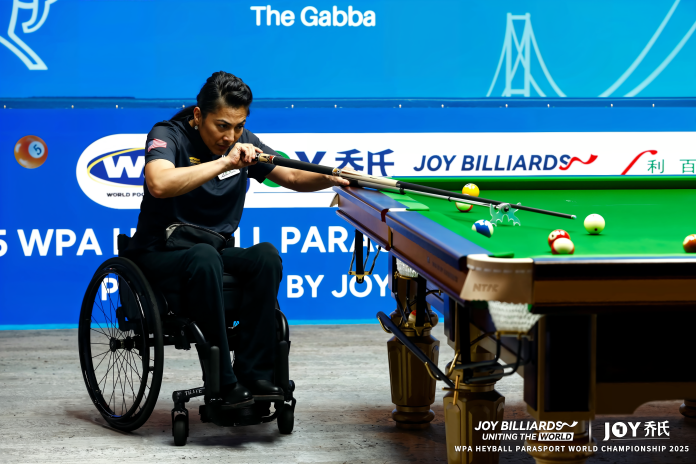
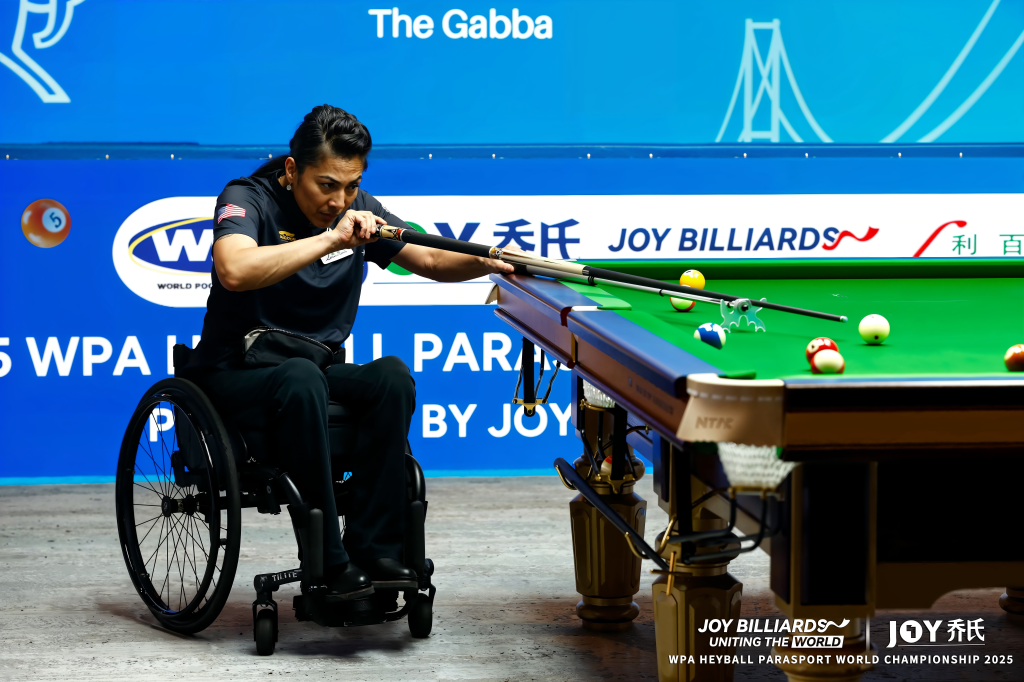
Every time I finished an essay or did well on a test, I would go to the pool hall with friends from high school. I found it meditative, and it didn’t require another person to play; I loved watching the ball glide from one side of the table to the other, a quiet, artistically beautiful ritual.
As my confidence and experience grew, I began competing in amateur events. I turned Semi-Pro in 2001, but I took ten years off when I started working with Clythess in her business as a hair stylist. I joined her when she would do weddings. We were so busy that I stopped playing pool, perfect timing, because I was in a slump and didn’t know how to climb out.
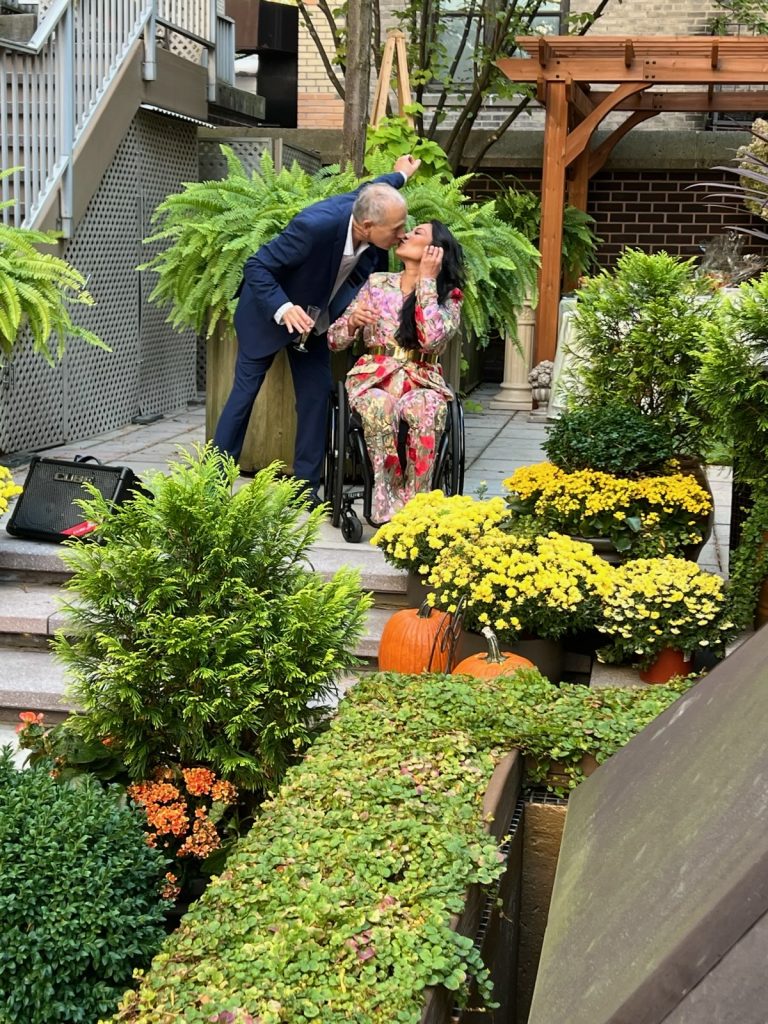
What was once a tragedy has now propelled me into a life I could not have imagined ten years ago, a life where walls loosen and horizons expand. Pool was not the only miraculous turn; it became a launchpad, but the bigger transformation was internal: a steadier voice, a clearer sense of direction, and a stubborn belief that a future could be designed rather than endured.
The work with my sister took me into a new economy of craft and collaboration, and for five years I worked at City Model Management in San Francisco as the company’s first wheelchair model. I was hired by Nordstrom, Mervyn’s, and Bon Marche in Seattle as a print model, each moment a testament to what is possible when talent meets tenacity.
It began with a whispered decision, a quiet vow that returned to the table not as a bravado but as a measured test: could I fall back into pool after a decade away, could the old rhythm survive the years of turbulence and the weight of a new life?
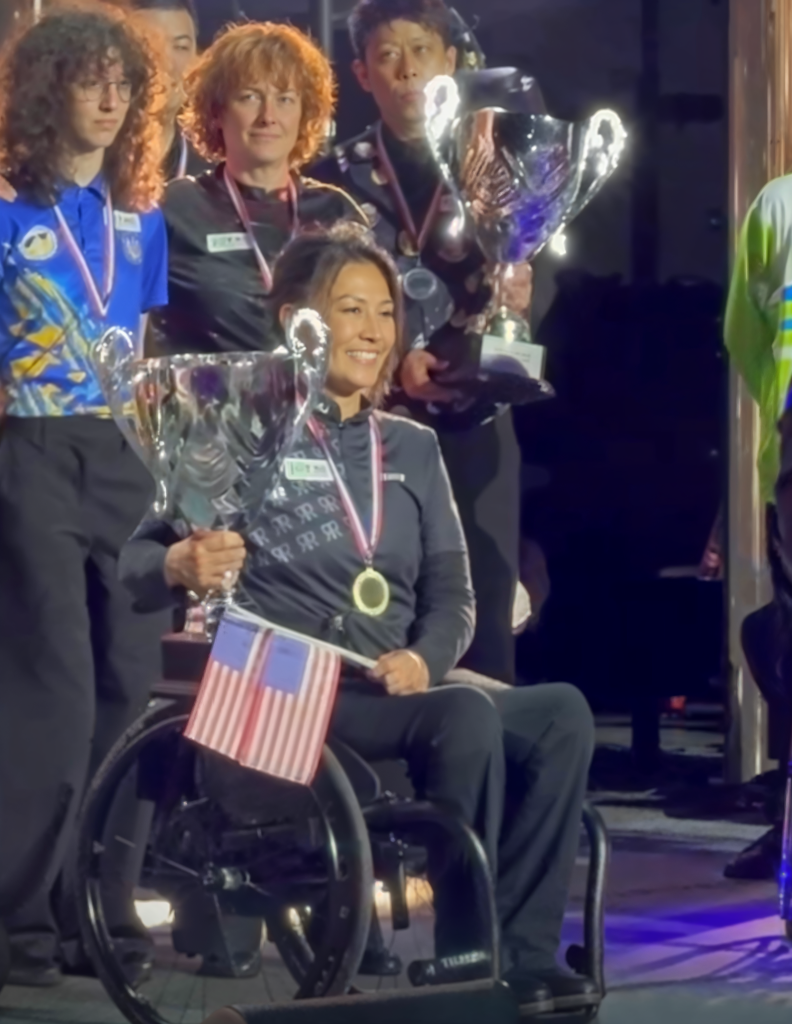
Slowly, my love for pool overwhelmed the frustration that had built up over years of absence, and I began to practice again with a stubborn, almost reverent focus—sometimes as little as two hours, sometimes as much as twelve. And then I stepped back into competition, climbing to championship heights—2024 World Pool Association (WPA) Heyball Parasport World Champion, Women’s Division, and 2025 World Pool Association Heyball Parasport World Champion, Women’s Mixed Division, competing in Sweden, Australia, Romania, Spain. Proof that resilience can translate into power, visibility, and a future I once could not have imagined.
Conclusion
In every line of this journey, tragedy did not become the final word but the opening page of a larger confession: that a life once defined by limits can be remade into a life defined by purpose. From the moment the car crashed and life tilted, she chose not to surrender to despair but to rebuild with stubborn grace. She learned to listen to a body that spoke in quieter, steadier tones, and she allowed a new rhythm to replace the old sprint.
She found strength in the quiet rituals—therapy, study, the discipline to start taking classes at City College, the courage to return to the pool table after a decade away, and the audacity to turn a wheelchair into a doorway rather than a wall. She leaned on the unwavering support of sisters and family, turning a house into a home that could weather any storm.
And as she carved a path into business, modeling, and world championships, she proved that resilience is not a single sprint but a long, luminous arc. To anyone facing tragedy, this story is a beacon: with grit, community, and a willingness to redefine possibility, even the most broken bones can become the framework for a life you never imagined—and a future worth fighting for.
——————————————————————————————————————-